The Returning Moon
The nights each month when the Moon comes home to the place she stood at your first breath — and the days she completes her turning.
Chandrama manaso jata — "the Moon was born from the mind of the cosmos," sings the Purusha Sukta, that ancient Vedic hymn of the cosmic being. Of all the lights in Vedic astrology, none lives closer to daily life than the Moon. Where the Sun is the steady soul, she is manas — the feeling mind, the part of us that receives, reflects, and responds. She is the swiftest of the planets, crossing a whole sign in a little over two days, and so she colours the texture of our moods, our rest, our appetite, our inner weather more intimately than any other body in the sky.
In Jyotish her importance is hard to overstate. The great cycle of timing that maps the seasons of a life is counted from the very stars she occupied at birth; the lunar mansions, the phases, and the choosing of auspicious days are all read from her course. She is the mother, the heart, the tides within the body. To know your Moon is, in a quiet and almost literal sense, to know how you meet the world from the inside — which is why so much of Vedic practice begins not with the Sun, but with her.
At the moment of your birth she stood at 21°22′ of Kanya (Virgo), in the lunar mansion of Hasta — and every twenty-seven days or so she returns there, tracing again the exact arc of stars she occupied when you arrived. This is your lunar return: not a birthday once a year, but a soft monthly homecoming. Where the bright new and full moons belong to the whole world at once, these returns are yours alone — a private tide that asks nothing of you but to be noticed.
Three rhythms are gathered here, nested like circles within circles. The return — the Moon back in Hasta, each month. The turning — your birth tithi, recurring each lunar month. And once a year, the Tithi Pravesh: that same turning opened wide, the doorway of your personal lunar year. Together they form a quiet, personal calendar you can keep beside the world's louder one.
Born at the Half-Lit Moon
Before the dates and their rhythms, pause a moment with the moon herself — the shape she wore the night you were born. You arrived under a moon held exactly half in light and half in shadow — the waxing quarter, poised midway between the dark and the full.
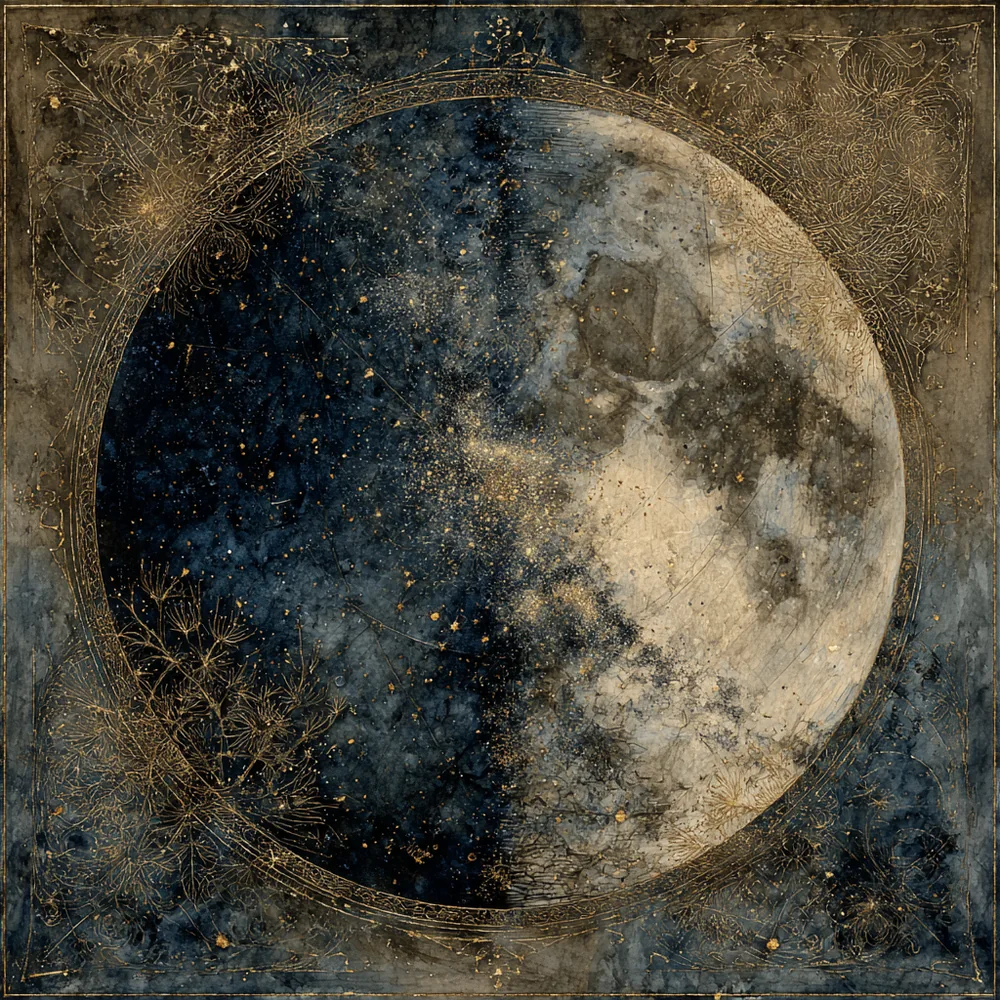
A first-quarter moon stands a quarter of the way around her circle from the Sun: a right angle of light, the exact midpoint of the brightening half of the month. Half her face is luminous, half still held in shadow, and neither is winning. This is the moon of poise — not the empty hush of the new moon, not the overflow of the full, but the balanced middle where light and dark are given equal weight. To be born here is to carry that equilibrium in the body: a nature able to hold the seen and the unseen, the finished and the not-yet-begun, without forcing them into one.
In the arc of the lunar month, the first quarter is the moment of commitment. The seed planted in the dark of the new moon has broken the soil; now it meets its first real resistance, and the half-moon is the turning where intention must become effort — where a thing has to be actively chosen and carried onward to keep growing. Yours is not a passive moon. She gathers her strength at the very point where work is asked of her, and then she gives it.
There is grace in this, too. In the tradition your birth tithi, Shukla Ashtami, the bright eighth, is honoured as a day of the Goddess — of Shakti gathering toward her fullness, of power poised and gathering before it moves. Maha Ashtami sits at the heart of the autumn Navaratri for exactly this reason. It is a fitting signature for a half-lit moon: the day the rising light reaches its balance-point and steadies itself for the climb to the full.
The Hand
Hasta means, quite simply, the hand. Its emblem is the open palm, and its gifts are all of what hands can do: to make, to mend, to hold, and to bless. Even Savitar, the deity who presides over these stars, is hymned in the old Veda as the golden-handed — the radiant giver who sets blessings into open palms. To be born with the Moon here is to feel, reach, and shape the world through the hands: a maker's intimacy with whatever you touch, and a gift for tending and healing what is placed in your care.
So the hand runs quietly through your whole sky — and through these pages too, perhaps unnoticed until now: the hand that cradles the moon above these words, and the others you will meet as you read on, one holding a moonstone, one reaching open toward her. They were never ornament. They are your own nakshatra, drawn again and again — the open hand you were born beneath, receiving and giving in a single gesture.
How Your Moon Moves
One gathers inward, one builds outward. Read together, they describe a way of working with intention that is true to your own chart rather than borrowed from elsewhere.
On any night you can ask the Moon two different questions: where is she among the stars? and what shape is she? Your two rhythms answer one each. The return follows her place — the Moon coming back to the exact stars she stood among at your birth. The turning follows her shape — the Moon returning to the phase she wore that day, your first-quarter moon. Because a journey through the stars takes a little less time than a journey through the phases, the two move at slightly different speeds, and so they keep their own separate dates.
The Return
This rhythm watches where the Moon is. It marks each time she comes home to Hasta, the lunar mansion she occupied at your birth — so the Moon is always in the same stars, though she may be full, dark, or anything between. Hasta is ruled by Chandra (Moon) and presided over by Savitar; its nature is one of craftsmanship, healing hands, and dexterity. The return is tender and inward — a day to rest, soften, and plant a seed-intention to gestate quietly. The work is receiving, not launching.
The Turning
This rhythm watches the Moon's shape — her angle to the Sun. It marks each return of your birth tithi, Shukla Ashtami, your first-quarter moon of about 49% light. The shape is always the same; only her sign changes, roaming month to month (noted on each date below). It is a building moon, gathering toward the full — a time for nourishing what is taking form, feeding it, and letting it grow.
Because their cycles differ by about two days, the return and the turning drift slowly in and out of step across the year — which is why they rarely share a date, and why each keeps its own column on this page.
Your Lunar Returns
The Moon back in Hasta, in your own the United Kingdom time. Each is the exact moment; the day around it carries the quality.
Your Monthly Turning
Shukla Ashtami as it returns each lunar month. The Moon's sign roams — noted beneath each date — so you can feel where it falls.
The Rhythm in View
The returns and turnings above, gathered onto a single timeline, so the shape of the months is visible at a glance — where a day to gather and rest and a day to tend and build fall close together, and where they stand apart. Returns sit above each line, turnings below; the day of the month is marked on each.
Your Year's Turning
Once each year, near your birthday, the Moon and Sun return to the very embrace they held at your birth — your birth tithi recurs in full. This is the Tithi Pravesh: the doorway of your personal lunar year, the same Shukla Ashtami that turns each month, now turning for the whole year.
At the doorway of the year
A year that opens on a rising breath. In the days around this date, settle on one true intention for the year ahead, plant it, and begin — gently — to feed it. The whole turning of the months will carry it toward the light.
The complete chart cast for this moment — its rising sign, its ruling planet, the shape of the year ahead — is a deeper reading in its own right. Here we simply mark the doorway, and the breath you take as you step through it.
Working With Her
On a return day — gather inward
Keep the day soft. Rise gently, take warm oil to the skin if you can, and protect a little silence. Light a single flame, sit with your Moon, and name one thing you wish to carry — not a task to complete, but a seed to hold. Write it, fold it away, and let Hasta do the ripening. Early nights especially; let sleep come before 10 pm.
On a turning day — tend and feed
This is the building motion. Tend what you planted at the return: water it with a little attention, take one nourishing step, and let it grow toward fullness. A day to add, not subtract.
And the world's bright moons
For the outward, expansive gestures — beginning, announcing, building — lean on the waxing Moon and the new and full moons in your Moon Calendar. Your returns and turnings are the inner cadence beneath that public rhythm.
Gather at the return · Tend at the turning · Act in the bright moon.
Her Stone, and a Mantra
Beyond the dates themselves, two quiet companions — one to wear, one to say — that speak straight to the Moon, and so to these days.
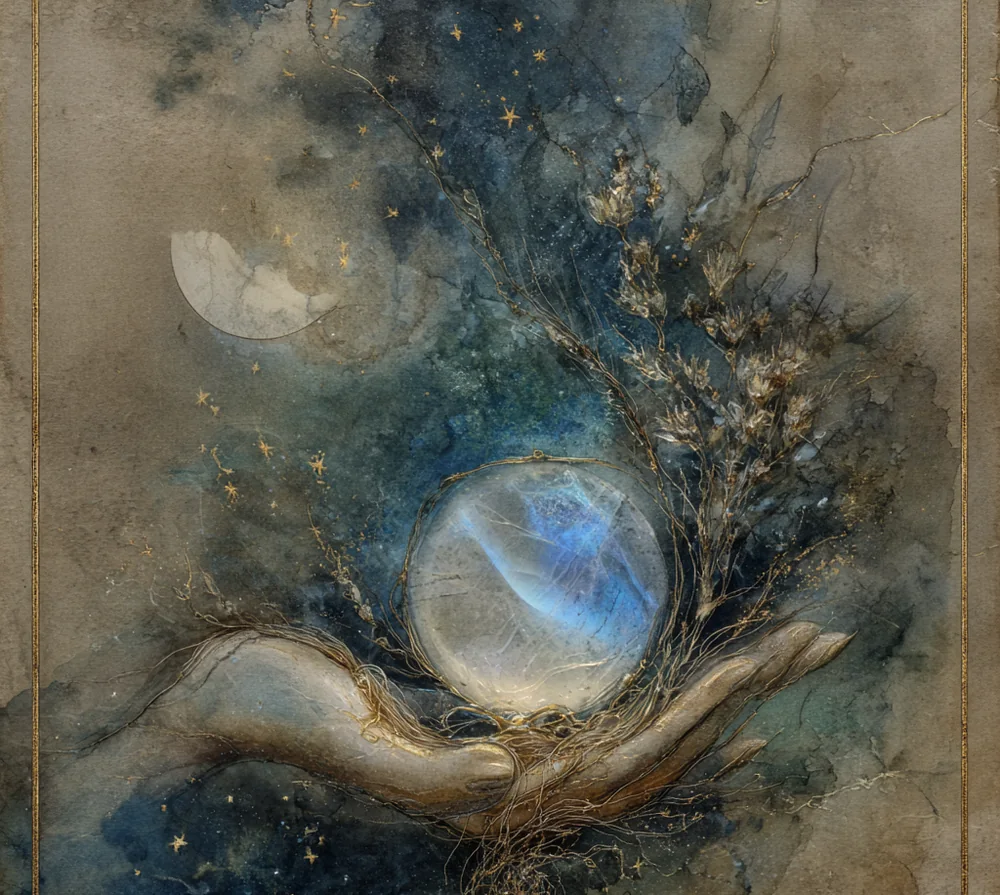
The Moon's own stone
In the tradition the Moon's stones are Pearl (Moti) and the gentler Moonstone (Chandrakanta) — set in silver, worn on the little finger, and first put on a Monday, the Moon's own day. For you they carry a rare weight, because the Moon stands threefold at the centre of your chart: she is the natural keeper of the feeling mind (manas), which a Moon stone soothes and steadies; she rules Hasta, the very lunar mansion your returns come home to; and she governs your house of rest and retreat, the quiet inner room these tender days invite you into. To honour the Moon is to honour all three at once.
Because she rules that inward house for you, wear her stone as an intentional companion — held in the hand, or worn especially around your return and turning days — rather than as an everyday charm. Begin gently with moonstone: rest it against the skin for a few days and notice your sleep and your mood, and let a Jyotish gem practitioner advise on size and setting before any lasting wear. A stone is an invitation, never a promise; it asks only that you listen.
A mantra for her moon days
The Moon's mantra is Om Shram Shreem Shroum Sah Chandraya Namah — a sound for emotional balance, clarity, and nourishment. Your house of devotion is well supported, its lord Jupiter sitting strong and high in the chart, so a full mala of 108 is within easy reach — or a quiet round of 27 on a fuller day. On a return day let it be slow and inward, a way of coming home to yourself; on a turning day let the same sound carry a building tone, fed gently toward what you are growing. If you take up a Moon stone, speak this mantra over it before you first wear it, and let stone and sound become a single practice.
You are not asked to do everything at once. The Moon doesn't. She gathers, she fills, she empties, and she comes home — and in coming home she shows you that nothing in you is ever lost, only carried, ripened, and returned.
This guidance is offered in the spirit of the Vedic sciences as a contemplative and lifestyle support — a way of keeping time with your own nature. It is not a substitute for medical or psychological care. Take from it what nourishes you, and leave the rest gently aside.